

IAS NOVA Academic Reference
Best Public Administration Dictionary for UPSC Optional: 502 Terms, 18 Sections and A–Z Quick Revision
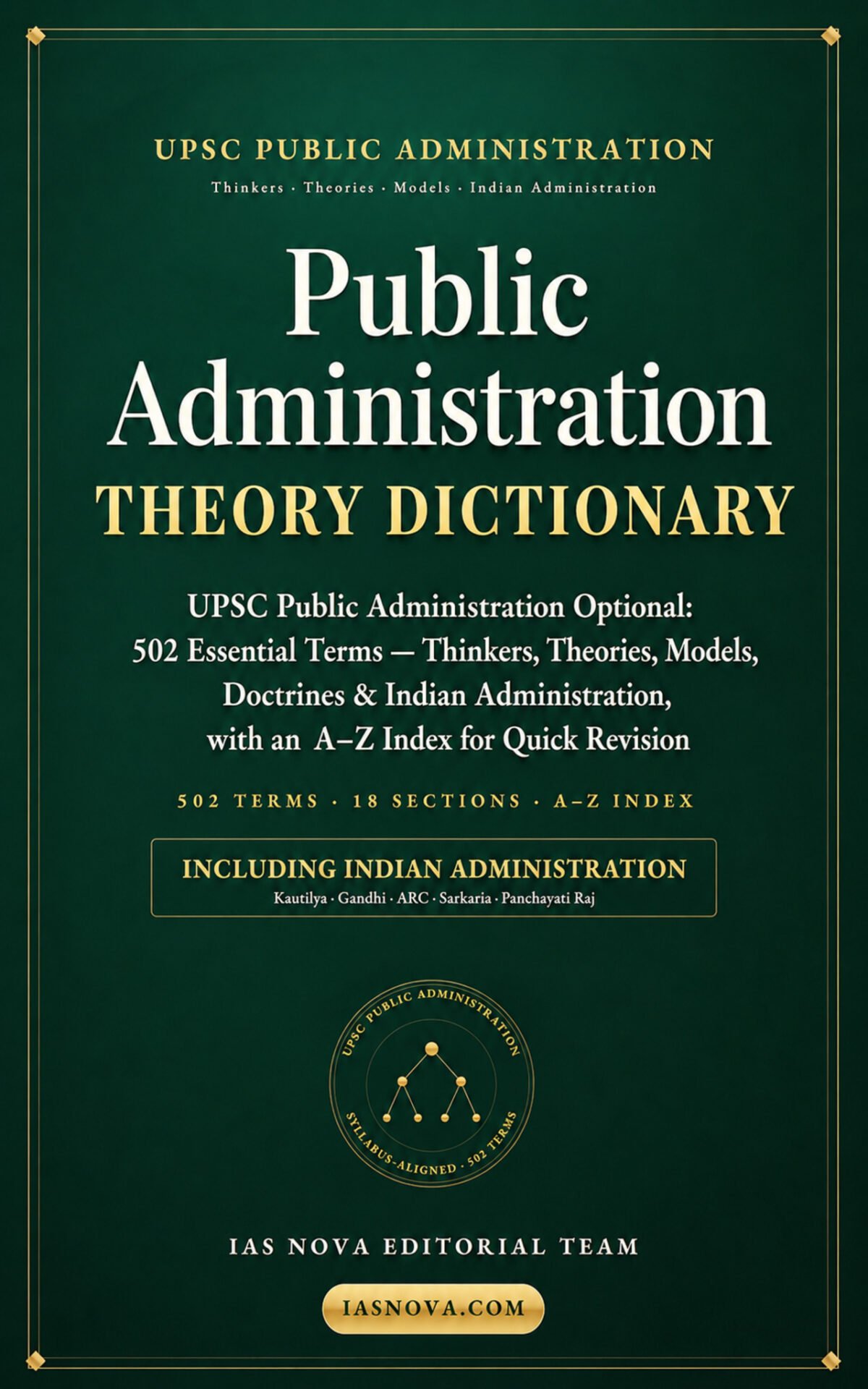
Public Administration Theory Dictionary is a syllabus-aligned academic reference for UPSC Civil Services Mains aspirants. It brings administrative thinkers, theories, models, doctrines and Indian Administration into one searchable, revision-friendly system.
Read on Kindle App
Why Public Administration aspirants need a specialised dictionary
The UPSC Public Administration Optional syllabus looks compact, but its vocabulary is spread across organisation theory, political science, management, administrative law, public policy, development studies, financial administration and Indian governance. Students often understand a broad topic yet struggle to recall the precise administrative term, thinker, model or doctrinal distinction needed in a Mains answer.
A conventional textbook explains themes chapter by chapter. Ordinary Public Administration Optional notes compress those chapters into points. A serious dictionary performs a different function: it gives every important concept a stable location, a clear definition, its intellectual association and its analytical limits. That makes it valuable for both learning and rapid retrieval.
Complete conceptual range
From Wilson, Taylor, Weber, Follett, Barnard and Simon to Riggs, public choice, governance, policy models, budgeting and Indian administrative reforms.
Indian Administration included
Kautilya, Mughal and British legacies, Union–State administration, district administration, civil services, Panchayati Raj, urban governance, ARC, policing and major governance issues.
Built for retrieval
Each entry has a stable PA code. In the interactive edition, the A–Z finder opens the definition directly, and the code returns the reader to the index.
Concepts remain connected
Terms are grouped around thinkers, schools, institutions and administrative problems, preventing definitions from becoming isolated fragments.
Useful for answer enrichment
The book helps convert general observations into Public Administration language: accountability, discretion, bounded rationality, ecology, public value, social audit and more.
Fast revision without random notes
The 18-section sequence and A–Z lookup system let aspirants revise systematically, then revisit only weak concepts before tests and the examination.
A comprehensive academic dictionary—not ordinary coaching notes
Public Administration Theory Dictionary is designed as a compact academic reference. It does not reduce thinkers to slogans or present disconnected one-line facts. Each definition identifies the concept, locates it within a thinker or administrative tradition, explains its significance and adds the qualification needed to avoid simplistic use.
For example, the politics–administration dichotomy is not treated as a claim that administration can ever be completely non-political. Bureaucratic neutrality is distinguished from administrative passivity. New Public Management is explained along with fragmentation, gaming and accountability concerns. Riggsian models are presented with their analytical purpose as well as their limitations. Indian institutions are connected with constitutionalism, federalism, decentralisation, accountability and reform.
The result is a dictionary that supports recall without sacrificing conceptual accuracy—the quality most short revision notes struggle to maintain.
Does the dictionary cover the complete UPSC Public Administration Optional syllabus?
Yes, it covers the conceptual vocabulary across every major topic listed in the official syllabus. The UPSC syllabus contains 12 Administrative Theory units and 14 Indian Administration units. The dictionary reorganises that terrain into 18 connected sections so related terms can be studied together rather than repeated under separate headings.
The mapping below follows the Public Administration syllabus published in the UPSC Civil Services Examination 2026 notification.
Administrative Theory: complete topic-by-topic coverage
| Official syllabus topic | How the dictionary covers it |
|---|---|
| 1. Introduction | Meaning, scope and significance of Public Administration; Woodrow Wilson; politics–administration dichotomy; evolution and identity of the discipline; New Public Administration; Minnowbrook; social equity; public choice; liberalisation, privatisation and globalisation; good governance; New Public Management; post-NPM; New Public Service; public value; network, collaborative and digital-era governance. |
| 2. Administrative Thought | F. W. Taylor and Scientific Management; mental revolution, time and motion study and functional foremanship; Fayol, Gulick, Urwick and classical principles; Weber’s bureaucracy, its dysfunctions and post-Weberian developments; Mary Parker Follett; Elton Mayo and the Human Relations School; Chester Barnard; Herbert Simon; Rensis Likert; Chris Argyris; Douglas McGregor; participative management. |
| 3. Administrative Behaviour | Decision-making processes and models; bounded rationality, satisficing and decision premises; incrementalism, mixed scanning, optimal and garbage-can models; motivation theories of Maslow, Herzberg, McClelland, Vroom and others; traditional, behavioural, contingency, situational, transformational and servant leadership; formal and informal communication, barriers, grapevine, morale and organisational climate. |
| 4. Organisations | Systems, structural-functional, contingency, socio-technical and institutional theories; mechanistic and organic systems; organisational culture and learning; ministries and departments; public corporations, government companies and departmental undertakings; boards, commissions, attached offices, field organisations, ad hoc and advisory bodies; headquarters–field relations; regulatory organisations; network and matrix forms; public-private partnerships. |
| 5. Accountability and Control | Finer–Friedrich debate; internal and external accountability; answerability and enforceability; ministerial responsibility; legislative, executive and judicial control; horizontal, vertical and diagonal accountability; citizen–administration relations; media, interest groups, voluntary organisations and civil society; Citizen’s Charter, Right to Information, social audit, transparency and responsiveness. |
| 6. Administrative Law | Rule of law; A. V. Dicey; droit administratif; administrative discretion; delegated legislation; natural justice; audi alteram partem; rule against bias; speaking orders; judicial review; administrative tribunals; ombudsman; Lokpal and Lokayukta. |
| 7. Comparative Public Administration | The comparative movement; Ferrel Heady and Fred W. Riggs; historical, cultural and sociological context; administrative ecology; structural-functional approach; fused, prismatic and diffracted societies; Sala and bazaar-canteen models; formalism, heterogeneity and overlapping; Agraria–Industria; comparative method and major criticisms of Riggs. |
| 8. Development Dynamics | Development Administration, administration of development and development of administration; change, goal and client orientation; institution building and administrative capability; bureaucracy and development; strong state versus market; anti-development thesis; liberalisation; participation, empowerment, capacity building and social capital; women in development, gender and development, self-help groups, inclusion, human development and sustainability. |
| 9. Personnel Administration | Human resource development; merit and spoils systems; rank and position classification; career and position systems; recruitment, training, competency and capacity building; career advancement, discipline, appraisal, promotion, lateral entry, pay and service conditions; employer–employee relations, associations and grievance redress; neutrality, commitment and activism; codes of conduct, administrative ethics, integrity and probity. |
| 10. Public Policy | Policy sciences and major scholars; rational, institutional, group, elite and systems models; policy cycle; agenda setting, formulation, adoption, implementation, monitoring, evaluation, feedback and review; multiple streams, advocacy coalitions and punctuated equilibrium; policy networks and communities; top-down and bottom-up implementation; implementation gap, policy failure, learning, transfer, nudges and state theories of public policy. |
| 11. Techniques of Administrative Improvement | Organisation and Methods; work study; Management Information System; PERT and CPM; network analysis; Total Quality Management; benchmarking; business-process re-engineering; performance management; e-governance, digital governance, interoperability and single-window administration. |
| 12. Financial Administration | Monetary and fiscal policy; public borrowing and public debt; line-item, performance, programme, PPBS, zero-based, outcome, gender and participatory budgeting; budgetary process and incrementalism; fiscal responsibility; financial and legislative control; accounts and audit; performance and value-for-money audit; economy, efficiency and effectiveness. |
Indian Administration: complete topic-by-topic coverage
| Official syllabus topic | How the dictionary covers it |
|---|---|
| 1. Evolution of Indian Administration | Kautilya and the Arthashastra; Saptanga, Rajdharma, Dandaniti, Amatya, Samaharta and Sannidhata; Mughal administrative traditions and Mansabdari; British district administration, Collector and the steel-frame legacy; Indianisation of services; revenue, district and local administration; Gandhi, Ambedkar, Nehru, Patel, Appleby and Gorwala. |
| 2. Philosophical and Constitutional Framework | Constitutionalism, constitutional morality and administrative safeguards; value premises; political culture; parliamentary administration; political and permanent executive; bureaucracy and democracy; bureaucracy and development; federal, cooperative, competitive and collaborative governance. |
| 3. Public Sector Undertakings | Public-sector role in modern India; departmental undertakings, public corporations and government companies; public-enterprise forms; autonomy–accountability dilemma; performance, control and regulatory issues; liberalisation, privatisation, marketisation and public-private partnerships. |
| 4. Union Government and Administration | Parliamentary and cabinet government; Prime Ministerial government; political executive–civil servant relations; Cabinet Secretariat, Central Secretariat and PMO; ministries and departments; boards and commissions; attached and field offices; constitutional, statutory and regulatory bodies; legislative and judicial control. |
| 5. Plans and Priorities | Centralised, indicative and decentralised planning; Planning Commission and National Development Council; NITI Aayog; plan formulation; district and metropolitan planning committees; constitutional decentralisation; economic development and social justice; Finance Commissions and cooperative policy institutions. |
| 6. State Government and Administration | Union–State administrative, legislative and fiscal relations; federal and intergovernmental relations; Governor, Chief Minister and Council of Ministers; Chief Secretary; State Secretariat and directorates; Finance Commission and State Finance Commission; cooperative, competitive and collaborative federalism. |
| 7. District Administration since Independence | District Collector and the changing post-Independence role; British legacy; revenue and development functions; district administration, democratic decentralisation, district planning, law and order, Union–State–local relations and development management. |
| 8. Civil Services | Constitutional position; structure, recruitment, training and capacity building; All India Services; merit, neutrality, anonymity, activism and political responsiveness; Mission Karmayogi; competency-based administration; performance appraisal; conduct, ethics, discipline, staff associations, political rights and grievance redress. |
| 9. Financial Management | Budget as a political instrument; parliamentary control of expenditure; Finance Ministry context; monetary and fiscal policy; accounting and audit; Comptroller and Auditor General of India; Controller General of Accounts; financial accountability, performance audit and value-for-money audit. |
| 10. Administrative Reforms since Independence | First and Second Administrative Reforms Commissions; Santhanam, Sarkaria, Punchhi, Hota and Surinder Nath committees and commissions; reform of human resources, O&M, finance, ethics, citizen-centric administration and local governance; Sevottam; implementation problems and institutional follow-through. |
| 11. Rural Development | Community Development Programme; rural-development institutions and strategies; Balwant Rai Mehta, Ashok Mehta, G. V. K. Rao and L. M. Singhvi; democratic decentralisation; 73rd Constitutional Amendment; Panchayati Raj, Gram Sabha, State Finance Commission, fiscal decentralisation and local-governance reform. |
| 12. Urban Local Government | 74th Constitutional Amendment; urban governance structures; municipal finance; metropolitan planning and governance; Municipal managerialism; parastatal agencies; localism and subsidiarity; development dynamics, politics and administration in city management. |
| 13. Law and Order Administration | British policing legacy; National Police Commission; investigative agencies; Union and State roles; law and order administration; counter-insurgency administration; police–public relations; criminalisation of politics and administration; police reforms and Supreme Court-linked reform principles. |
| 14. Significant Issues in Indian Administration | Values and ethics in public service; regulatory commissions; National Human Rights Commission; coalition administration; citizen–administration interface; corruption; social accountability and grievance redress; crisis and disaster management; governance reform, transparency and citizen-centric administration. |
How 502 terms are organised into 18 sections
The dictionary does not mechanically reproduce the official syllabus order. It reorganises overlapping areas into coherent intellectual clusters, reducing repetition and making conceptual revision faster.
- Foundations and Evolution of Public Administration
- Scientific Management and Classical Organization Theory
- Bureaucratic Theory and Post-Weberian Developments
- Human Relations and Behavioural Approaches
- Decision-Making and Administrative Behaviour
- Motivation, Leadership, Communication and Morale
- Organization Theories and Administrative Forms
- Public Choice, Managerialism and Contemporary Governance
- Accountability, Administrative Responsibility and Administrative Law
- Comparative Public Administration and Administrative Ecology
- Development Administration
- Public-Policy Theories and Models
- Personnel Administration, Civil Services and Administrative Ethics
- Financial Administration and Administrative-Improvement Techniques
- Indian Administrative Thought and Historical Traditions
- Constitutional and Institutional Doctrines of Indian Administration
- Indian Planning, Local Administration and Development Institutions
- Administrative Reforms and Significant Issues in Indian Administration
Can the complete Public Administration syllabus be revised within hours?
The dictionary can help an aspirant revise the conceptual skeleton of the syllabus within hours after completing a first reading. It is not a promise that 502 concepts can be mastered from zero in one sitting. Its advantage is structured retrieval: the reader scans familiar definitions, reconnects thinkers with terms and identifies weak areas through the A–Z finder.
A six-hour Public Administration quick-revision plan
| Time | Revision target | Method |
|---|---|---|
| 0:00–0:30 | Thinkers, theories and administrative traditions map | Scan the full architecture and mark weak clusters. |
| 0:30–1:40 | Sections 1–5 | Foundations, classical theory, bureaucracy, human relations and decision-making. |
| 1:40–2:40 | Sections 6–9 | Motivation, leadership, organisations, governance, accountability and administrative law. |
| 2:40–3:35 | Sections 10–14 | Comparative and development administration, public policy, personnel, ethics, finance and improvement techniques. |
| 3:35–5:20 | Sections 15–18 | Indian administrative thought, constitutional institutions, planning, local administration, reforms and significant issues. |
| 5:20–6:00 | A–Z weak-term retrieval | Open marked terms, revise distinctions and create final answer-writing clusters. |
How the dictionary improves Public Administration answer writing
UPSC answers become recognisably administrative when concepts are used to explain a problem—not merely inserted as names. The dictionary supports a simple recall chain:
Question theme → relevant thinker or framework → associated administrative concepts → Indian application → balanced judgement
Accountability question
Recall Finer–Friedrich, internal and external accountability, ministerial responsibility, legislative control, judicial review, RTI, social audit and citizen-centric administration.
Decision-making question
Compare rational-comprehensive choice with Simon’s bounded rationality, Lindblom’s incrementalism, Etzioni’s mixed scanning and the garbage-can model.
Indian reform question
Connect ARC recommendations, Sarkaria and Punchhi, civil-service reform, Mission Karmayogi, Sevottam, police reform, grievance redress and social accountability.
This method helps students write sharper introductions, organise the body around competing frameworks and finish with a reasoned administrative judgement. It also reduces vague statements such as “bureaucracy should be efficient” by supplying precise concepts such as bounded rationality, representative bureaucracy, public value, network accountability, subsidiarity, fiscal decentralisation and performance audit.
Who should use Public Administration Theory Dictionary?
- Beginners who need a reliable vocabulary before reading dense theories and institutional debates.
- Students attending coaching who want a stable reference for terms scattered across class notes.
- Self-study aspirants who need a syllabus-aligned map of thinkers, models, doctrines and Indian Administration.
- Test-series candidates who want to enrich answers with correct terminology and conceptual comparisons.
- Repeat candidates who understand the subject but need rapid recall before Mains.
- Last-week revisers who want one systematic source instead of reopening several bulky books.
The dictionary also helps with selected General Studies themes—governance, transparency, civil services, accountability, ethics, federalism, local government and administrative reform—but it is primarily designed for UPSC Public Administration Optional.
What the book should be used with
A high-quality dictionary is a recall engine and conceptual reference, not a replacement for every component of preparation. For the strongest results, use it with:
- the official UPSC syllabus and previous-year questions;
- standard Public Administration books and original thinkers where required;
- current examples from government reports, commissions, court decisions and administrative developments;
- regular answer-writing practice and evaluation; and
- personal micro-notes for contemporary case studies and data.
This combination preserves academic depth while giving the aspirant a fast and dependable revision system.
Frequently asked questions
Is this the best Public Administration dictionary for UPSC Optional?
It is designed specifically for that role: 502 essential terms, 18 syllabus-aligned sections, administrative thinkers and theories, Indian Administration coverage, stable lookup codes and an interactive A–Z finder. Its combination of academic definitions and fast navigation makes it especially strong for optional-subject revision.
Does the book cover both Administrative Theory and Indian Administration?
Yes. It covers the complete conceptual range of Administrative Theory as well as Indian administrative evolution, constitutional institutions, public enterprises, Union and State administration, district administration, civil services, financial management, reforms, rural and urban governance, law and order and significant administrative issues.
Does it include the full UPSC Public Administration syllabus?
The dictionary covers the important concepts, thinkers, models and doctrines across all 12 Administrative Theory units and all 14 Indian Administration units in the official syllabus. It is organised into 18 conceptual sections to avoid repetition and improve recall.
Can I revise the whole syllabus within hours using this book?
If you have already completed a first reading, you can use the section map and A–Z finder to revise the conceptual skeleton within a focused six-hour session. First-time mastery will require slower study, standard sources and answer-writing practice.
Is this book suitable for beginners?
Yes. Beginners can use it to understand the vocabulary of the subject and locate thinkers, theories and institutions. It is most effective when one section is studied alongside the corresponding syllabus topic and standard reading.
How does the A–Z index work in the digital edition?
Every listed term links to its full definition. The stable PA code attached to each entry links back to the same term in the A–Z finder, allowing fast bidirectional navigation without repeatedly scrolling through the book.
Does the dictionary contain Indian thinkers and reform bodies?
Yes. Coverage includes Kautilya, Gandhi, Ambedkar, Nehru, Sardar Patel, Paul Appleby and A. D. Gorwala, along with the First and Second ARC, Sarkaria Commission, Punchhi Commission, Santhanam Committee, Hota Committee, police reform bodies and major Panchayati Raj committees.
Can the dictionary replace Public Administration Optional notes?
It can replace scattered glossary notes and significantly reduce revision material, but it should complement rather than replace previous-year questions, current administrative examples, answer practice and deeper reading of difficult topics.
Turn the entire optional syllabus into a revisable conceptual system
Public Administration Theory Dictionary gives UPSC aspirants one organised source for 502 terms across thinkers, theories, models, doctrines and Indian Administration—with an A–Z index built for quick revision.
Students in India can buy the dictionary on Amazon.in and read it conveniently on the Kindle app on a phone, tablet or computer.
View on Amazon IndiaOfficial syllabus reference: Union Public Service Commission, Civil Services Examination 2026 notification, Public Administration syllabus. View the official UPSC notification.
★ IASNOVA.COM ★
