

IAS NOVA Academic Reference
Best Sociology Theory Dictionary for UPSC Optional: 579 Terms, 15 Sections and A–Z Quick Revision
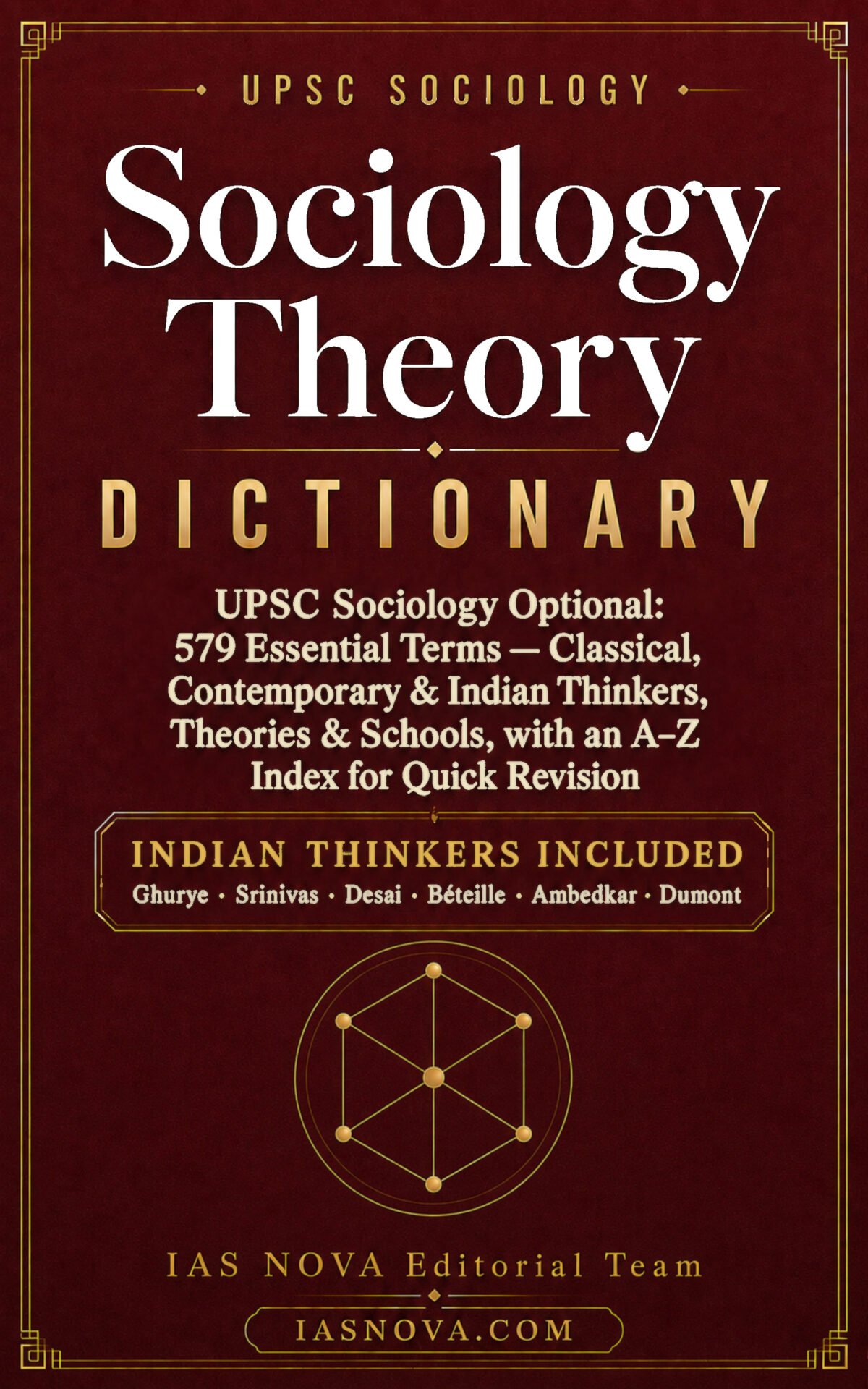
Sociology Theory Dictionary is a syllabus-aligned academic reference for UPSC Civil Services Mains aspirants. It brings classical, contemporary and Indian thinkers, theories, schools and core sociological concepts into one searchable, revision-friendly system.
Read on Kindle App
Why Sociology Optional needs a specialised theory dictionary
The UPSC Sociology Optional syllabus moves from epistemology and research methods to Marx, Durkheim, Weber, Parsons, Merton and Mead; then to stratification, work, power, religion, kinship and social change; and finally to Indian society, caste, tribes, classes, agrarian transformation, urbanisation, movements, population and inequality. The challenge is not only reading these topics. It is recalling the right concept, thinker, theoretical contrast and Indian application when writing a timed Mains answer.
A textbook explains an argument at length. Ordinary Sociology Optional notes compress chapters into bullet points. A serious dictionary serves a different purpose: it gives each important term a stable location, a clear definition, its intellectual association and the qualification needed for accurate use. That makes it useful for first-stage concept building, answer enrichment and final-stage recall.
Classical foundations
Comte and early evolutionism, Marx and Marxist theory, Durkheim and the Durkheimian school, Weber and interpretive sociology.
Contemporary sociology
Functionalism, interactionism, dramaturgy, conflict theory, critical theory, structuralism, practice, power, feminism, postcolonialism and late modernity.
Indian thinkers included
G. S. Ghurye, M. N. Srinivas, A. R. Desai, André Béteille, B. R. Ambedkar, Louis Dumont and other Indian conceptual traditions.
Concepts remain connected
Terms are grouped around thinkers, schools and substantive problems so definitions do not become isolated facts.
Built for retrieval
Each entry has a stable T code. In the interactive edition, the A–Z finder opens the definition and the code returns to the same index location.
Useful for answer enrichment
General statements can be converted into sociological analysis through concepts such as anomie, social closure, habitus, dominant caste and graded inequality.
A comprehensive academic dictionary—not ordinary coaching notes
Sociology Theory Dictionary is designed as a compact academic reference. Its definitions are concise formulations of established sociological concepts. They identify what a term means, locate it within a thinker or tradition, explain its analytical value and add a necessary qualification where a concept is debated or often oversimplified.
For example, Marx’s class concepts are not reduced to a slogan about rich and poor. Durkheim’s social facts are distinguished from individual facts. Weber’s ideal type is treated as an analytical construction rather than an ideal in the moral sense. Sanskritization is presented as a process of mobility and cultural emulation, not as a complete explanation of structural equality. Dumont’s hierarchy is placed alongside power and class approaches associated with Srinivas, Béteille and Ambedkar.
The result is a revision reference that compresses reading without flattening theory—the balance serious Sociology Optional preparation requires.
Does the dictionary cover the complete UPSC Sociology Optional syllabus?
It covers the essential conceptual vocabulary and theoretical frameworks across every major topic in the official syllabus. The first part of the syllabus contains 10 broad units under Fundamentals of Sociology. The Indian Society component covers perspectives, social structure and processes of social change. The dictionary reorganises this terrain into 15 intellectual clusters so connected concepts can be revised together.
The mapping below follows the Sociology syllabus published in the UPSC Civil Services Examination 2026 notification.
Fundamentals of Sociology: complete topic-by-topic coverage
| Official syllabus topic | How the dictionary covers it |
|---|---|
| 1. Sociology—The Discipline | Modernity and social transformation in Europe; Enlightenment, industrialisation and the emergence of sociology; the sociological imagination; structure and agency; micro–macro relations; sociology’s scope; relations with other social sciences; common sense, typification and reflexivity. |
| 2. Sociology as Science | Science and scientific method; positivism and its critique; methodological holism and individualism; interpretivism, verstehen and hermeneutics; explanation and understanding; fact–value distinction, objectivity and value neutrality; standpoint, reflexivity and non-positivist approaches. |
| 3. Research Methods and Analysis | Qualitative and quantitative strategies; survey, ethnography, interview, observation, case study and comparative-historical inquiry; concepts, variables and hypotheses; sampling; reliability and validity; triangulation, operationalisation, causation, correlation and researcher reflexivity. |
| 4. Sociological Thinkers | Karl Marx—historical materialism, mode of production, alienation and class struggle; Émile Durkheim—division of labour, social fact, suicide and religion; Max Weber—social action, ideal type, authority, bureaucracy and the Protestant ethic; Talcott Parsons—social system and pattern variables; Robert K. Merton—manifest and latent functions, reference groups, conformity and deviance; G. H. Mead—self, identity, I and Me, role-taking and the generalized other. |
| 5. Stratification and Mobility | Equality, inequality, hierarchy, exclusion, poverty and deprivation; Marxist, Weberian and functional theories; class, status, gender, race and ethnicity; social closure, life chances, cultural capital, intersectionality and cumulative disadvantage; open and closed systems; vertical, horizontal, intergenerational and intragenerational mobility. |
| 6. Works and Economic Life | Organisation of work in slave, feudal and industrial-capitalist societies; division of labour, alienation and labour process; formal and informal organisation; Taylorism, Fordism, post-Fordism and flexible accumulation; bureaucracy, organisations, professions, precarity, emotional labour and labour-market segmentation. |
| 7. Politics and Society | Theories of power, domination and hegemony; power elite, ruling class, bureaucracy, pressure groups and parties; nation, state, citizenship, democracy, civil society and ideology; collective behaviour, resource mobilisation, political process, new social movements, protest, revolution and collective action. |
| 8. Religion and Society | Durkheimian, Marxian and Weberian approaches to religion; animism, sacred and profane, ritual, mana, church, sect and cult; theodicy and religious ethics; secularisation and its critique; civil and invisible religion; pluralism, revivalism and fundamentalism. |
| 9. Systems of Kinship | Family, household and marriage; types and forms of family; lineage, descent, alliance and kinship structures; patriarchy, gendered kinship and sexual division of labour; domestic cycle, family–household distinction and contemporary changes in intimate and household relations. |
| 10. Social Change in Modern Society | Evolutionary, Marxist, functional, conflict, structuration, modernisation and multiple-modernities perspectives; development, underdevelopment and dependency; agents and movements of social change; education, science and technology; globalisation, risk, networks, environment and reflexive modernisation. |
Indian Society: Structure and Change—complete topic-by-topic coverage
| Official syllabus topic | How the dictionary covers it |
|---|---|
| Perspectives on Indian Society | Indology and the book view associated with G. S. Ghurye; structural-functionalism, field view and social change associated with M. N. Srinivas; Marxist sociology of India, nationalism, state and class associated with A. R. Desai. Comparative terms also bring in Dumont, Béteille and Ambedkar. |
| Impact of Colonial Rule | Colonial transformation; social background of Indian nationalism; capitalist path of development; modernisation of Indian tradition; protests, peasant struggles and organised collective action; social reform, cultural revolt and constitutional change. |
| Rural and Agrarian Social Structure | Indian village as a social system; village and little-community studies; book view and field view; jajmani system; rural–urban continuum; semi-feudalism; agrarian classes, modes of production, land relations, peasant struggles and planned change. |
| Caste System | Ghurye’s features of caste; Srinivas’s Sanskritization, dominant caste and secularisation of caste; Dumont’s purity–pollution, hierarchy and Homo Hierarchicus; Béteille’s caste–class–power and cumulative versus dispersed inequality; Ambedkar’s graded inequality, enclosed class, division of labourers and annihilation of caste; untouchability, endogamy and mobility. |
| Tribal Communities in India | Tribes as backward Hindus, tribe as indigenous people and tribe–caste continuum; social ecology and nature–man–spirit complex; colonial classifications; geographic and cultural diversity; tribal autonomy, Tribal Panchsheel, absorption, integration and ethnicity–nationality–citizenship. |
| Social Classes in India | Agrarian and industrial class structures; class-in-itself and class-for-itself; peasantry, working class, middle class, labour, semi-feudal relations and capitalist development; caste–class–power and the intersection of class with status, gender and ethnicity. |
| Systems of Kinship in India | Kinship zones, linguistic regions, lineage and descent; family and marriage; family–household distinction; household dimensions of jointness; seed-and-earth metaphor; patriarchy, entitlements, sexual division of labour, gendered kinship and Brahmanical patriarchy. |
| Religion and Society in India | Religious communities, pluralism and minority-group relations; sacred complex, great and little traditions, universalisation and parochialisation; religion as a non-secularised world; secularisation, communalism, revivalism, identity and citizenship. |
| Visions of Social Change in India | Planned change, mixed-economy development, state and class; Constitution, constitutional morality, law and social democracy; Gandhi’s Sarvodaya, Antyodaya, trusteeship and Gram Swaraj; Ambedkarite change; education, cultural modernisation and the dialectic of tradition and modernity. |
| Rural and Agrarian Transformation | Community and planned development; cooperatives and poverty interventions as institutional change; Green Revolution, dominant caste and agrarian differentiation; capitalist and semi-feudal modes of production; rural labour, bondage, class mobilisation and push–pull migration. |
| Industrialisation and Urbanisation | Industrial society, capitalist development and labour process; working-class structure and mobilisation; formal and informal work; rural–urban continuum, urbanism as a way of life and migration; precarity, informalisation, child labour, slums, exclusion and urban deprivation. |
| Politics and Society in India | Nation, democracy, citizenship, state and civil society; vote bank, dominant caste, political class, elites and pressure-group processes; ethnicity, regionalism and identity; decentralisation, Gram Swaraj, secularisation and constitutional morality. |
| Social Movements in Modern India | Social movement as organised collective effort; peasant and farmers’ struggles; women’s movements and feminist standpoints; backward-class, anti-caste and Dalit movements; environmental movements; tribal, ethnic, identity and cultural-revolt frameworks. |
| Population Dynamics | Census classification, demographic transition, migration and push–pull models; population size, growth, composition and distribution; birth, death and migration as components of change; ageing, sex ratios, mortality, reproductive health and the links among demography, family, development and inequality. |
| Challenges of Social Transformation | Development crisis, displacement, environmental risk and sustainability; poverty, deprivation and unequal development; violence against women, patriarchy and intersectionality; caste conflict and everyday discrimination; ethnic conflict, communalism and religious revivalism; illiteracy, educational inequality and social exclusion. |
How 579 terms are organised into 15 sections
The dictionary does not mechanically copy the official syllabus order. It reorganises overlapping themes into coherent theoretical families. This reduces repetition and allows a student to move from a thinker to related debates and applications.
- Metatheory and Sociological Explanation
- Early Sociology and Evolutionary Traditions
- Karl Marx and Marxist Theory
- Émile Durkheim and the Durkheimian School
- Max Weber and Interpretive Sociology
- Parsons, Merton and Functional Analysis
- Interactionism, Dramaturgy and Everyday Order
- Conflict, Elite and Critical Theories
- Structuralism, Power, Practice and Late Modernity
- Feminist, Intersectional and Postcolonial Theory
- Stratification, Mobility, Race and Exclusion Theories
- Work, Organization and Collective-action Theories
- Theories of Religion, Kinship, Socialization and Deviance
- Development, Education, Globalization and Environmental Theory
- Indian Sociological Thinkers and Conceptual Traditions
Can the complete Sociology Optional syllabus be revised within hours?
The dictionary can help an aspirant revise the conceptual skeleton of the syllabus within hours after a first reading. It is not a claim that all 579 concepts can be mastered from zero in one sitting. Its strength is retrieval: familiar definitions can be scanned quickly, thinkers can be reconnected with concepts and weak areas can be reopened through the A–Z finder.
A six-hour Sociology Optional quick-revision plan
| Time | Revision target | Method |
|---|---|---|
| 0:00–0:30 | Whole-book map and A–Z scan | Review the 15 sections, mark weak thinkers and identify recurring syllabus concepts. |
| 0:30–1:45 | Sections 1–5 | Metatheory, early traditions, Marx, Durkheim and Weber. |
| 1:45–3:00 | Sections 6–10 | Functionalism, interactionism, conflict, power, late modernity, feminism and postcolonial theory. |
| 3:00–4:00 | Sections 11–14 | Stratification, work, organisations, religion, kinship, deviance, development, education, globalisation and environment. |
| 4:00–5:30 | Section 15 | Indian thinkers and traditions: caste, village, kinship, tribe, nationalism, change, democracy, movements and demography. |
| 5:30–6:00 | A–Z weak-term retrieval | Open marked entries, compare paired concepts and create final answer-writing clusters. |
How the dictionary improves Sociology Optional answer writing
A strong Sociology answer does more than describe society. It defines the issue sociologically, uses a relevant thinker or perspective, compares explanations and applies the framework to Indian evidence. The dictionary supports a repeatable recall chain:
Question theme → precise concept → thinker or school → competing perspective → Indian application → balanced conclusion
Caste question
Connect Ghurye’s features, Srinivas’s Sanskritization and dominant caste, Dumont’s hierarchy, Béteille’s caste–class–power and Ambedkar’s graded inequality and annihilation of caste.
Bureaucracy question
Start with Weber’s legal-rational authority and ideal type, then add Merton’s dysfunctions, Gouldner’s patterns, Crozier’s uncertainty and the wider relation between organisation and power.
Social change question
Compare Marxian transformation, Durkheimian differentiation, Weberian rationalisation, modernisation and dependency with Srinivas, Desai, Ambedkar and Indian traditions of planned and constitutional change.
This method helps create sharper introductions, concept-led subheadings and conclusions that recognise complexity. It also replaces vague phrases with analytical language such as social closure, anomie, status group, habitus, intersectionality, dominant caste, cumulative inequality, demographic transition and constitutional morality.
Who should use Sociology Theory Dictionary?
- Beginners who need the vocabulary of sociology before approaching dense thinkers and theoretical debates.
- Students attending coaching who want one stable reference for terms scattered across lectures and Sociology Optional notes.
- Self-study aspirants who need a syllabus-aligned map of classical, contemporary and Indian sociology.
- Test-series candidates who want to enrich answers with precise concepts, comparisons and thinker linkages.
- Repeat candidates who understand the subject but need faster retrieval before the examination.
- Last-week revisers who want a systematic source instead of reopening several bulky books.
The book can also support selected General Studies and Essay themes—caste, gender, family, inequality, religion, urbanisation, movements, population and social change—but it is primarily designed as a UPSC Sociology Optional book.
What the dictionary should be used with
A high-quality theory dictionary is a conceptual reference and recall engine, not a replacement for every part of Sociology preparation. For the strongest use, combine it with:
- the official UPSC syllabus and previous-year questions;
- standard Sociology texts and original thinkers where deeper interpretation is required;
- current Indian examples, studies, reports and relevant data;
- regular answer-writing practice and evaluation; and
- personal micro-notes for contemporary case studies and scholar quotations.
This combination preserves academic depth while giving the aspirant a fast and dependable revision system.
Frequently asked questions
Is this the best Sociology theory dictionary for UPSC Optional?
It is purpose-built for UPSC Sociology Optional: 579 essential terms, 15 theory-led sections, classical and contemporary schools, extensive Indian thinkers and conceptual traditions, stable lookup codes and a bidirectional A–Z finder. This combination makes it especially useful for concept building, retrieval and revision.
Does the dictionary cover the complete UPSC Sociology Optional syllabus?
It covers the essential concepts and theoretical frameworks across every major syllabus area—from discipline, methods and thinkers to stratification, work, politics, religion, kinship and change, plus Indian society, caste, tribes, classes, movements, population and social transformation.
Does it include classical, contemporary and Indian sociological thinkers?
Yes. It covers Marx, Durkheim, Weber, Parsons, Merton and Mead; major functionalist, interactionist, conflict, critical, structuralist, feminist, postcolonial and late-modern approaches; and Indian thinkers including Ghurye, Srinivas, A. R. Desai, Béteille, Ambedkar and Dumont.
Can I revise the whole Sociology syllabus within hours?
After a first reading, the 15-section map and A–Z finder can be used to revise the syllabus’s conceptual skeleton in a focused six-hour session. First-time mastery needs slower study, standard sources, examples and answer practice.
How strong is the coverage of Indian sociological thinkers?
The dedicated Indian section contains 92 entries. It connects perspectives on Indian society with caste, village, tribe, kinship, class, nationalism, democracy, movements, development, demography and social change.
Is the Sociology Theory Dictionary suitable for beginners?
Yes. Beginners can use it to understand unfamiliar vocabulary and locate each term within a thinker or school. It is most effective when one section is studied alongside the corresponding syllabus topic and deeper reading.
How does the A–Z index work in the digital edition?
Every term in the A–Z finder links to its full definition. The stable T code attached to the entry links back to the same index location, allowing quick two-way navigation without repeated scrolling.
Can the dictionary replace Sociology Optional notes?
It can replace scattered glossary notes and substantially compress conceptual revision. It should still be used with previous-year questions, current Indian examples, answer writing and deeper reading of difficult thinkers and debates.
Turn the entire optional syllabus into a revisable conceptual system
Sociology Theory Dictionary gives UPSC aspirants one organised source for 579 terms across classical, contemporary and Indian thinkers, theories and schools—with an A–Z index built for quick revision.
Students in India can buy the dictionary on Amazon.in and read it conveniently on the Kindle app on a phone, tablet or computer.
View on Amazon IndiaOfficial syllabus reference: Union Public Service Commission, Civil Services Examination 2026 notification, Sociology syllabus. View the official UPSC notification.
★ IASNOVA.COM ★
