The Big Five Personality Traits: Complete OCEAN Model Guide for UPSC & Psychology Exams

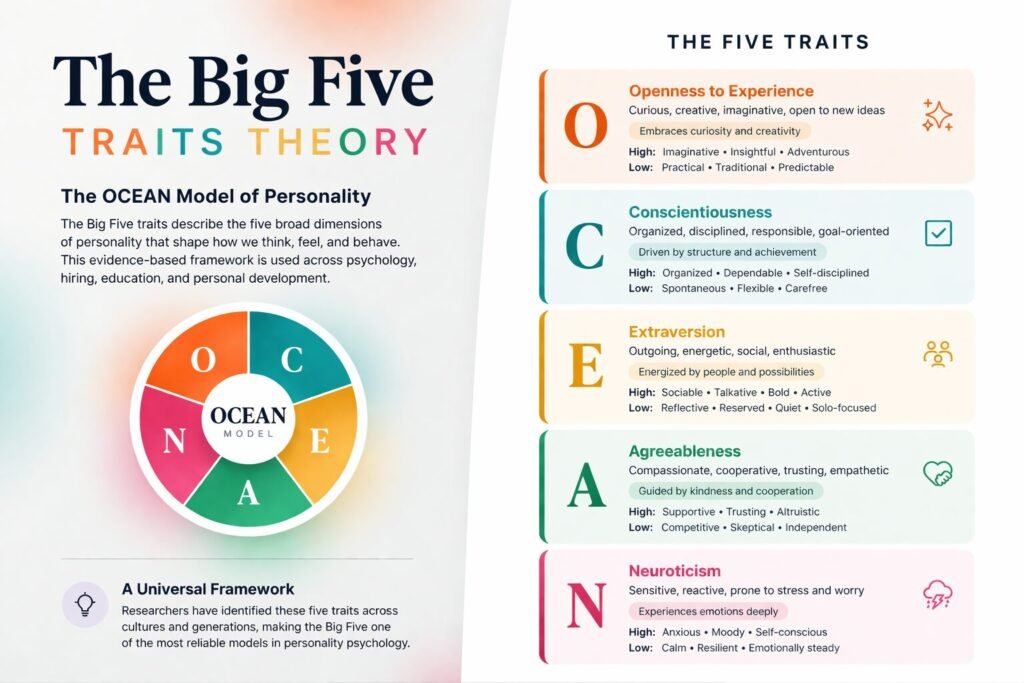
Master the Big Five Personality Traits (OCEAN Model) with this research-backed interactive guide. Perfect for UPSC (Psychology Optional) aspirants, GRE/Psychology Subject Test candidates in the USA, and A-Level/University students across Europe. Explore the five dimensions—Openness, Conscientiousness, Extraversion, Agreeableness, and Neuroticism—through a scientifically validated lens to ace your exams and understand human behavior.

IASNOVA.COM
IASNOVA.COM
IASNOVA.COM
Psychology Deep Dive · IASNOVA.COM

The Big Five
Personality Traits

The most scientifically validated framework in personality psychology — explore the OCEAN model, what it measures, what science says, and how it shapes every aspect of human life.

Evidence-Based Research Interactive Self-Exploration 40+ Years of Science Comprehensive Guide
© IASNOVA.COM — All Rights Reserved. Unauthorized reproduction prohibited.

What Is the Big Five Personality Model?

The Big Five Personality Traits — also known as the Five-Factor Model (FFM) or the OCEAN model — is the gold standard framework in contemporary personality psychology. Unlike pop-psychology assessments, the Big Five emerges directly from empirical, data-driven research conducted across decades, cultures, and languages.

Rather than fitting people into neat “types,” the Big Five measures personality as five broad, continuous dimensions. Every person sits somewhere on each spectrum — from very low to very high — and this unique combination forms their personality profile. This dimensional approach is far more nuanced and predictively powerful than categorical systems like MBTI.

The model is widely used in clinical psychology, organizational behavior, educational research, health psychology, and cross-cultural studies. Its robustness comes from replication across 50+ cultures, strong heritability evidence (roughly 40–60% genetic), and its predictive validity for key life outcomes including career success, relationship quality, mental health, and longevity.

🧠
Why OCEAN and not MBTI? The Big Five is built from thousands of personality-describing words statistically distilled into underlying factors. Myers-Briggs types are based on Jungian theory with binary categories, offering weak test-retest reliability (~50% retype within weeks). The Big Five demonstrates far higher reliability (r ≈ 0.70–0.85 over a month) and predictive validity for real-world outcomes.
40+
Years of Research
56
Cultures Validated In
50%
Avg. Heritability
30
Specific Facets Measured
O
Openness
C
Conscient.
E
Extraversion
A
Agreeable.
N
Neuroticism
IASNOVA.COM · Psychology Series

Deep Dive Into Each Trait

Click any trait to expand its complete profile — including the spectrum, sub-facets, behavioral patterns, career implications, relationship dynamics, and neuroscience findings.

IASNOVA.COM

Openness to Experience reflects the breadth, depth, and permeability of consciousness. Highly open individuals are intellectually curious, artistically inclined, emotionally expressive, and drawn to novelty and complexity. They tend to have rich inner lives, vivid imaginations, and an appreciation for beauty — in art, nature, and ideas. Low scorers prefer routine, practicality, and concrete thinking, and can be more resistant to change.

Low (Conventional)High (Open)
Six Core Facets (NEO-PI-R)
Fantasy / Imagination
Aesthetics
Feelings / Emotions
Actions (Novelty-seeking)
Ideas / Intellect
Values / Liberalism
High Openness
  • Embraces abstract thinking
  • Seeks novel experiences
  • Strong aesthetic sensibility
  • Open to unconventional ideas
  • Rich fantasy life
  • Politically liberal tendency
Low Openness
  • Prefers familiar routines
  • Pragmatic, concrete thinker
  • Conventional aesthetic tastes
  • Traditional values
  • Practical orientation
  • Conservative tendency
Career Paths & Strengths
Artist / Designer Scientist / Researcher Writer / Philosopher Entrepreneur Therapist Architect
Neuroscience & Biology

Research links high Openness to dopaminergic activity in the brain, particularly in circuits involved in reward and exploration. Open individuals show greater functional connectivity in the default mode network (the “imagination network”) and tend to demonstrate faster cognitive processing in divergent thinking tasks. Studies show a moderate positive correlation with fluid intelligence and working memory capacity.

Life Outcomes & Research Findings

High Openness is one of the strongest personality predictors of creative achievement. It correlates with higher educational attainment, lower religious conservatism, higher likelihood of trying novel foods, and greater tolerance for ambiguity. Longitudinally, it predicts adaptive coping and is linked to better cognitive functioning in old age.

🔬 Research insight: Openness is the only Big Five trait significantly correlated with IQ (r ≈ 0.30–0.45), suggesting it captures a real blend of aesthetic and intellectual curiosity that overlaps with cognitive ability.
© IASNOVA.COM — Content Protected
IASNOVA.COM

Conscientiousness is the degree to which a person exercises self-regulation, organization, and goal-directed behavior. It is arguably the single most important personality trait for real-world success. Highly conscientious people are reliable, hardworking, disciplined, and deliberate. They think before acting, plan carefully, and follow through on commitments. Low scorers are more spontaneous, flexible, and sometimes disorganized.

Low (Spontaneous)High (Disciplined)
Six Core Facets (NEO-PI-R)
Competence
Order / Organization
Dutifulness
Achievement Striving
Self-Discipline
Deliberation
High Conscientiousness
  • Organized, methodical planner
  • Reliable and punctual
  • Goal-driven and persistent
  • Thinks before acting
  • Strong work ethic
  • Follows rules and obligations
Low Conscientiousness
  • Spontaneous and flexible
  • May procrastinate
  • Dislikes rigid structure
  • Lives in the moment
  • Can be creative in chaos
  • Adaptable but unreliable
Career Paths & Strengths
Executive / Manager Surgeon / Doctor Accountant / Analyst Engineer Military / Law Academic Researcher
Neuroscience & Prefrontal Cortex

Conscientiousness is strongly linked to the prefrontal cortex (PFC) — the brain’s executive control center. High scorers show greater PFC gray matter volume and activity during inhibitory control tasks. It is associated with regulation of serotonin and dopamine pathways. Damage to the PFC (e.g., through brain injury) reliably decreases conscientiousness-related behaviors.

Health & Longevity Research

Conscientiousness is the strongest personality predictor of longevity (Howard S. Friedman’s Longevity Project). High scorers live ~2–4 years longer on average, have lower rates of obesity, smoking, substance use, and non-compliance with medical treatment. They exercise more, sleep better, and maintain healthier diets — all downstream of self-regulatory capacity.

📊 Meta-analysis finding: Conscientiousness has the highest correlation with job performance (r ≈ 0.23–0.31) across nearly all occupations, making it the most robust personality predictor in industrial/organizational psychology.
IASNOVA.COM · Psychology Series · Unauthorized Copy Prohibited
IASNOVA.COM

Extraversion reflects a person’s orientation toward the external social world. Extraverts are energized by social interaction, tend to be assertive, talkative, enthusiastic, and experience more frequent positive emotions. Critically, Extraversion is not just about being “outgoing” — it is fundamentally about reward sensitivity and positive affect. Introverts are not anti-social; they simply require less external stimulation and recharge through solitude.

Low (Introverted)High (Extraverted)
Six Core Facets (NEO-PI-R)
Warmth
Gregariousness
Assertiveness
Activity Level
Excitement-seeking
Positive Emotions
High Extraversion
  • Energized by social settings
  • Assertive communicator
  • Experiences frequent joy
  • Seeks excitement and thrills
  • Natural leadership style
  • Large social networks
Low Extraversion (Introversion)
  • Recharges in solitude
  • Prefers deep 1:1 conversations
  • Reflective before speaking
  • Independent work style
  • More selective socially
  • Less sensation-seeking
Career Paths & Strengths
Sales / Marketing Leadership / CEO Public Speaker Teacher / Coach Actor / Entertainer HR / Recruiter
The Neuroscience of Reward

Extraversion is rooted in the brain’s behavioral activation system (BAS) — sensitivity to reward signals. Hans Eysenck originally proposed that introverts have higher baseline cortical arousal, requiring less external stimulation to reach optimal levels. Modern research connects Extraversion to dopaminergic reward pathways, particularly in the nucleus accumbens. Extraverts show greater amygdala reactivity to positive stimuli.

💡 The “introvert advantage”: While extraverts excel in fast-paced social settings, introverts perform better on tasks requiring sustained concentration and deep thought. Susan Cain’s research highlights how modern workplaces may systematically undervalue introverted strengths.
© IASNOVA.COM — All Content Watermarked
IASNOVA.COM

Agreeableness reflects individual differences in prosocial motivation and interpersonal harmony. Highly agreeable people are empathetic, cooperative, trusting, and focused on others’ needs. They value social harmony and are skilled at managing conflict through accommodation. At the low end of the spectrum, individuals tend to be more competitive, skeptical, and prioritize personal interests — which can be adaptive in certain negotiation or leadership contexts.

Low (Competitive)High (Cooperative)
Six Core Facets (NEO-PI-R)
Trust
Straightforwardness
Altruism
Compliance
Modesty
Tender-mindedness
High Agreeableness
  • Warm, empathetic, nurturing
  • Avoids conflict instinctively
  • Trusts others easily
  • Generous and helpful
  • Accommodating in disputes
  • Strong social bonds
Low Agreeableness
  • Competitive and assertive
  • Skeptical of intentions
  • Prioritizes personal goals
  • Blunt communicator
  • Doesn’t avoid confrontation
  • Strategic in relationships
Career Paths & Strengths
Nurse / Social Worker Teacher / Counselor Mediator / Diplomat Veterinarian Community Leader Nonprofit Work
Gender, Culture & the Agreeableness Gap

Agreeableness shows the largest and most consistent gender difference of all Big Five traits, with women scoring higher on average across almost every culture studied. This gap widens in more gender-egalitarian societies — a counterintuitive finding known as the “gender equality paradox.” Cross-cultural research confirms high-Agreeableness cultures tend to be more collectivist and emphasize social harmony.

⚖️ The Agreeableness “penalty”: Low agreeableness (particularly in men) is associated with higher salaries and faster career advancement in competitive environments — but at the cost of relationship quality and social support networks. High agreeableness predicts relationship satisfaction and volunteer behavior but can lead to burnout from over-giving.
IASNOVA.COM · Psychology Deep Dive
IASNOVA.COM

Neuroticism (sometimes called Emotional Instability or its positive pole, Emotional Stability) captures the tendency to experience negative emotions with greater frequency, intensity, and duration. High Neuroticism is associated with emotional volatility, stress sensitivity, and a negativity bias in perception. People low in Neuroticism are emotionally stable, resilient, and calm under pressure. Importantly, Neuroticism is not a character flaw — it reflects a genuine neurobiological difference in how the brain processes threat and uncertainty.

Low (Emotionally Stable)High (Neurotic)
Six Core Facets (NEO-PI-R)
Anxiety
Angry Hostility
Depression
Self-consciousness
Impulsiveness
Vulnerability to Stress
High Neuroticism
  • Frequent worry and anxiety
  • Mood swings
  • Highly empathetic / sensitive
  • Deep emotional processing
  • Strong motivational reactivity
  • Driven by fear of failure
Low Neuroticism (Stability)
  • Calm under pressure
  • Emotionally resilient
  • Slow to worry or ruminate
  • Handles stress effectively
  • Even-tempered, predictable
  • High frustration tolerance
Mental Health Connections

High Neuroticism is the single strongest personality risk factor for psychopathology. It predicts lifetime risk for major depressive disorder, generalized anxiety disorder, PTSD, and bipolar disorder. It also functions as a transdiagnostic vulnerability factor — the “p-factor” in mental health research suggests Neuroticism underlies a broad spectrum of disorders. Conversely, emotional stability is one of the key ingredients of psychological resilience.

The Upside of Neurotic Traits

High Neuroticism is not purely maladaptive. Research shows neurotic individuals often have higher empathy, produce more original creative work under stress, show better performance in certain deadline-driven contexts, and exhibit the “neurotic advantage” in threat detection — they spot dangers others miss. Some studies link moderate Neuroticism with greater academic persistence driven by fear-motivated effort.

🎭 Cultural note: Neuroticism levels vary significantly by country. Research shows higher average Neuroticism in Southern and Eastern Europe compared to Northern Europe, and this correlates with historical trauma, socioeconomic instability, and cultural norms around emotional expression.
© IASNOVA.COM — Protected Content · Psychology Series

Build Your Personality Profile

Adjust the sliders to explore how different Big Five profiles look. Load a preset archetype to see famous personality patterns — purely illustrative, based on research-described profiles.

Personality Radar Visualizer

Drag sliders · Load presets · See your OCEAN shape

IASNOVA.COM
Adjust sliders above to see your personality profile description update here.
© IASNOVA.COM — Interactive Tool

A Century of Personality Science

The Big Five did not emerge overnight. It is the product of over a century of lexical research, factor analysis, and cross-cultural replication — a convergence of independent scientific traditions arriving at the same five-factor structure.

1936
Allport & Odbert compile ~18,000 personality-describing words from Webster’s dictionary — the foundation of the lexical hypothesis: “personality is encoded in language.”
1945–1947
Raymond Cattell reduces Allport’s list to 171 terms and through factor analysis identifies 16 primary personality factors — the 16PF model.
1949–1963
Donald Fiske (1949) and later Ernest Tupes & Raymond Christal (1961) independently replicate a 5-factor solution from Cattell’s data, marking the first clear emergence of the Big Five structure.
1981
Lewis Goldberg coins the term “Big Five” and leads the International Personality Item Pool (IPIP) project — creating publicly available Big Five measures.
1985–1992
Paul Costa & Robert McCrae develop the NEO Personality Inventory (NEO-PI), operationalizing the Big Five with 30 specific facets — still the gold-standard clinical instrument today.
1992–2000s
Cross-cultural replication studies across 56 nations by McCrae, Terracciano et al. confirm the Five-Factor structure is culturally universal, present even in non-literate societies and independently discovered via observer ratings.
2003–Present
Behavioral genetics research (twin and adoption studies) confirms Big Five traits are 40–60% heritable. Genome-wide association studies (GWAS) begin identifying specific genetic loci linked to trait variation.
2020s
Machine learning research uses social media data (Facebook likes, Twitter language patterns) to predict Big Five scores with accuracy exceeding human judgment — raising ethical debates about personality surveillance.
IASNOVA.COM · Research Timeline

Big Five vs. Other Models

The Big Five is the dominant scientific model but not the only personality framework. Understanding how it compares helps contextualize its strengths and limitations.

Framework Dimensions Scientific Basis Reliability Best Used For
Big Five / FFM 5 continuous traits Empirical factor analysis, cross-cultural Very High (r ≈ 0.75) Research, clinical assessment, workplace prediction
MBTI 16 binary types Jungian theory-based Low–Moderate (50% retype) Team communication workshops, self-awareness intro
HEXACO 6 traits (+Honesty-Humility) Cross-linguistic lexical studies High Ethics research, dark triad/integrity screening
Cattell 16PF 16 primary factors Factor analysis of lexical data High Clinical profiling, vocational guidance
Eysenck PEN 3 traits (P/E/N) Biological/neurological theory High Neurobiological research, criminology
Enneagram 9 types Spiritual tradition, not empirical Low–Moderate Spiritual development, coaching contexts
© IASNOVA.COM — All Rights Reserved

Where the Big Five Matters Most

The Big Five is not a personality curiosity — it has substantial predictive power across major life domains. Here are the most evidence-backed applications:

💼
Workplace & Career Conscientiousness predicts job performance across virtually all occupations. Extraversion predicts success in sales and leadership. Openness predicts performance in creative and innovative roles. Many Fortune 500 companies integrate Big Five assessments in talent selection.
❤️
Relationships & Marriage Agreeableness and low Neuroticism are the strongest predictors of relationship satisfaction. Neuroticism is the most robust personality risk factor for divorce. Partners with complementary (not necessarily similar) Big Five profiles often report higher compatibility.
🏥
Health & Longevity High Conscientiousness is linked to a 2–4 year longer lifespan. High Neuroticism increases cardiovascular disease risk. Agreeableness predicts better immune function and lower inflammation markers. Openness protects against cognitive decline in aging.
🎓
Education & Academic Performance Conscientiousness is the strongest Big Five predictor of GPA, surpassing even IQ in some studies. Openness predicts breadth of knowledge and intellectual engagement. Neuroticism predicts test anxiety and academic dropout rates.
🧘
Mental Health & Therapy The Big Five maps onto the DSM’s dimensional model of personality disorders. High Neuroticism underlies anxiety, depression, and borderline traits. Therapy outcomes correlate with trait changes — effective CBT reduces Neuroticism by measurable amounts over time.
🗳️
Politics & Society Openness is the strongest political personality predictor — high scorers lean liberal, low scorers lean conservative. Conscientiousness slightly predicts conservatism. The Cambridge Analytica scandal demonstrated how Big Five data can be weaponized for micro-targeted political persuasion.
IASNOVA.COM · Applications Module

Frequently Asked Questions

Can your Big Five personality change over time?
Yes — personality is not fixed. Research by Brent Roberts and colleagues shows consistent patterns of change across the lifespan, called “personality maturation.” Conscientiousness and Agreeableness tend to increase with age, especially through the 20s and 30s. Neuroticism tends to decrease with age. However, the pace of change is gradual, and dramatic personality shifts are rare without significant life events, therapy, or other interventions. Rank-order stability (who is most conscientious relative to peers) is moderately high (r ≈ 0.50–0.70 over a decade).
Is the Big Five the same as the OCEAN model?
Yes — OCEAN is simply the acronym for the five traits: Openness, Conscientiousness, Extraversion, Agreeableness, Neuroticism. The terms “Big Five,” “Five-Factor Model (FFM),” and “OCEAN model” all refer to the same framework. The acronym OCEAN is commonly used as a memory aid in educational and popular psychology contexts.
How is the Big Five measured?
The gold standard is the NEO Personality Inventory Revised (NEO-PI-R), a 240-item questionnaire measuring all five traits and their 30 facets. Shorter validated versions include the BFI (Big Five Inventory, 44 items), the TIPI (10-item), and the IPIP-NEO (public domain). Free assessments are available at IPIP.ori.org. Self-report is most common, but observer-rated versions (where others rate you) often show higher predictive validity for behavioral outcomes.
Is there a “best” Big Five profile?
No — there is no universally ideal personality profile. Different contexts reward different trait configurations. High Conscientiousness is almost universally adaptive, and low Neuroticism generally correlates with wellbeing. But high Agreeableness can lead to exploitation in competitive environments; high Extraversion may overwhelm in solitary creative work; high Openness may signal instability to conservative institutions. The “best” profile depends entirely on your context, goals, and environment. Trait diversity in teams is often more productive than homogeneity.
What is the relationship between personality and mental health disorders?
The Big Five maps closely onto the DSM-5’s Alternative Model of Personality Disorders (AMPD). High Neuroticism is a transdiagnostic risk factor shared by anxiety disorders, depression, PTSD, and borderline personality disorder. Low Agreeableness relates to antisocial and narcissistic patterns. Low Conscientiousness predicts substance use disorders. The “p-factor” (general psychopathology factor) is strongly correlated with Neuroticism, suggesting a deep connection between emotional instability and vulnerability to mental illness.
Can the Big Five predict criminal behavior?
Research shows that low Agreeableness, low Conscientiousness, and high Neuroticism collectively predict a range of antisocial behaviors and criminal involvement. The “dark triad” personality pattern (narcissism, Machiavellianism, psychopathy) maps onto extremely low Agreeableness in the Big Five. However, personality is one of many contributing factors — socioeconomic context, trauma, and environmental factors are equally if not more important. Personality never deterministically causes criminal behavior.
© IASNOVA.COM · FAQ Section
Share this post:

Log In

Forgot password?

Forgot password?

Enter your account data and we will send you a link to reset your password.

Your password reset link appears to be invalid or expired.

Log in

Privacy Policy

Add to Collection

No Collections

Here you'll find all collections you've created before.